Author Archives: jstueart

Unknown's avatar

About jstueart

Jerome writes science fiction/ fantasy and queer fiction and has been published in many magazines and journals including The Magazine of Fantasy and Science Fiction, Lightspeed, Fantasy, Tor.com, Strange Horizons. His first collection, The Angels of Our Better Beasts, was published in 2016 and was shortlisted for the Sunburst Award. His work was/is a finalist for the Eugie Award and the World Fantasy Award. He also makes art---acrylic paintings and small watercolor paintings. He holds a PhD in English and is currently working on an MA in Engaged Humanities and the Creative Life at Pacifica Graduate Institute. He lived for 10 years in the Yukon Territory, but now lives in Columbus OH.

Jefferson’s Creative Approach to the Bible: Crafting His Own Sacred Text

Standard

Thomas Jefferson, considered one of the major “Founding Fathers” of the United States of America, created for himself a Bible, cut and pasted from the scriptures of his own Bible.  He threw out what he considered repetition and hearsay–and stuck with just the moral teachings of Jesus Christ.  He worked on this in private mostly, in his seventies.  It’s a remarkable artifact of literature, a composed text created from another text.  A personally sacred text crafted from a publicly sacred text.

This little video was created by the University of Virginia and features the Smithsonian.


Not every believer takes everything their sacred texts or churches tell them—and visually Jefferson captured what metaphorically many believers craft–their own version of their faith.  They cut and paste what’s important.

Can you think of a character who might be more eclectic in their approach to their faith, taking what they find important and extricating it from the stuff they find unimportant?  Not every representation of Faith has to be an all or nothing approach—a perfect Buddhist, a perfect Christian.  In reality, believers are all seekers, crafters, negotiators.


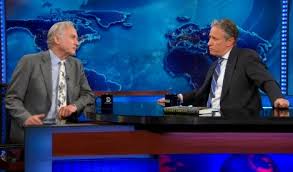
Richard Dawkins and Jon Stewart’s intelligent discussion of Faith and Science

Standard
jon stewart richard dawkins

Click on this to go to the Extended Interview Part 1 on the Daily Show.

Check out this beautiful segment of the Daily Show. Richard Dawkins meets Jon Stewart. Jon holds his own in talking about Faith vs. Science–a topic Dawkins has talked about a lot.  Jon brings up some valid points about faith and science both being good when in good hands, and both being evil in evil hands.

This segment is entitled: Will the World End by Crazies driven by their Faith or Crazies driven by their Science?

This is only part 1 of a 3 part extended interview. But it’s very thought provoking. In the next segment, which is my favorite (but which I couldn’t find in a Youtube or WordPress acceptable source) Richard Dawkins and Jon talk specifically about Faith. Find the rest of this extended interview by clicking on this link EXTENDED INTERVIEW WITH RICHARD DAWKINS

Was Beethoven inspired by the Bhagavad Gita?

Standard

Lit Hum seems to think so, and they have a quote from Beethoven’s diary:

Blessed is the man who, having subdued all his passions, performeth with his active faculties all the functions of life, unconcerned about the event… Be not one whose motive for action is the hope of reward. Perform thy duty, abandon all thought of the consequence, and make the event equal, whether it terminate in good or evil; for such an equality is called yoga.

                         – A quote from the Bhagavad Gita that Beethoven wrote into his diary

Beethoven never really professed a leaning towards any one faith, but took a more eclectic approach.  It’s nice to think that some of the most revered musicians used sacred texts and religious scriptures as a springboard to their masterpieces.

Perhaps you’ll find an inspiration in the Gita too!

Dancing on the Head of a Pen: the Pope as Character Struggling with Faith

Standard

We’d like to start posting a variety of faith-themed articles that we find in the news–not for their theological superiority, but because of their on-the-ground rethinking of faith and its impact on folks around them.  See them as characters struggling with their faith—even if it’s the POPE.

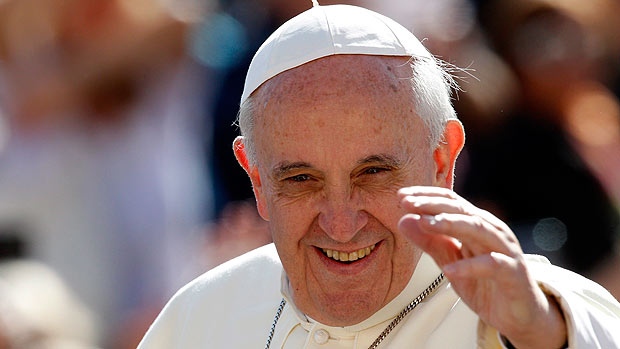
Yep, first up is Pope Francis’ radical announcement Friday that the Catholic Church needs to stop obsessing with gay marriage and abortion—that there is a more inclusive message of their faith that is being crowded out by all the negativity.  Francis, in this article and in others, seems genuinely concerned that there are people who have turned away from the faith because of the dogmatic approach of the Catholic Church.  No longer is it a “scripture over people” paradigm. Francis seems to be suggesting a reversal: a “people over scripture”– without sacrificing the Truth, as he sees it.  Catch his “loyal son of the church” throw-away clause, and you may suspect that what he is advocating might be a more pragmatic marketing of the Faith.  But, to his favour, his paradigm shift also seems to call attention to HOW folks talk about faith–and whether or not a message of Love and Acceptance can breathe in a room of toxic rules.  He seems validly concerned that a faith can be killed by too much of its own toxicity.  Faith, maybe, should have bite–a corrective correlative, else why follow it–but it shouldn’t devour its faithful like a zombie.  (No Zombie Jesus jokes–i know you almost can’t help it!)

I’m going to include the beginning of the CBC article below.  After that, I’ve included a link to the Pope’s full interview, and then a link to a cool Debate in the NYT this morning about the Pope’s comments and their impact on the church and the everyday person.

Again, this is not meant as a promotion of Catholic values, a veneration of the Pope, but to look at a) the Pope as character (finely, and humorously, done in the film We Have a Pope as well); b) the turning of doctrine or practice in a Faith–how that happens; and c) the impact of a large denomination on millions of followers–and how differently they might react to a new decree.

Enjoy your Pope Tart for the morning.  You may find it sweet inspiration for a story.

___________________________________________________
imagePOPE FRANCIS SAYS CHURCH TOO OBSESSED WITH GAYS AND ABORTION

Pope Francis is warning that the Catholic Church’s moral edifice might “fall like a house of cards” if it doesn’t balance its divisive rules about abortion, gays and contraception with the greater need to make the church a merciful, more welcoming place for all.

Six months into his papacy, Francis set out his vision for the church and his priorities as Pope in a remarkably candid and lengthy interview with La Civilta Cattolica, the Italian Jesuit magazine. It was published simultaneously Thursday in other Jesuit journals, including America magazine in the U.S.

In the 12,000-word article, Francis expands on his ground-breaking comments over the summer about gays and acknowledges some of his own faults. He sheds light on his favourite composers, artists, authors and films (Mozart, Caravaggio, Dostoevsky and Fellini’s La Strada) and says he prays even while at the dentist’s office.

‘The church sometimes has locked itself up in small things, in small-minded rules.’– Pope Francis

But his vision of what the church should be stands out, primarily because it contrasts so sharply with many of the priorities of his immediate predecessors John Paul II and Benedict XVI. They were both intellectuals for whom doctrine was paramount, an orientation that guided the selection of generations of bishops and cardinals around the globe.

Francis said the dogmatic and the moral teachings of the church were not all equivalent.

“The church’s pastoral ministry cannot be obsessed with the transmission of a disjointed multitude of doctrines to be imposed insistently,” Francis said. “We have to find a new balance; otherwise even the moral edifice of the church is likely to fall like a house of cards, losing the freshness and fragrance of the Gospel.”

Rather, he said, the Catholic Church must be like a “field hospital after battle,” healing the wounds of its faithful and going out to find those who have been hurt, excluded or have fallen away.

“It is useless to ask a seriously injured person if he has high cholesterol and about the level of his blood sugars!” Francis said. “You have to heal his wounds. Then we can talk about everything else.”

For more of the CBC article, click here. 

For the Pope’s FULL INTERVIEW in America Magazine, “A Big Heart Open to God” (full of other shockers!) click here.

For the NYT Room for Debate of the impact of the Pope’s new direction/directives, click here. 

The Room For Debate has five short responses that include: Praise for a Pope who is putting the poor over a war on abortion; one who condemns the Pope for causing irrevocable damage with his words; the impact on Hispanic Catholics and more….

(And now a few more articles, and then Liana and I will start discussing and debating our own thoughts on faith–and hoping you’ll chime in)

As always, you may feel free to comment.  We’d appreciate it–since we are talking about religion and faith–that we stay civil, attacking no one’s religion or faith.  Noting the character arc of the Pope or the character arc of a denomination might be fun though.  🙂

Tesseracts 18: Open for Submissions!

Standard

Zeus and Io CorreggioWrestling With Gods — Faith in Science Fiction & Fantasy

Well this is an all new topic for Tesseracts!  And possibly a completely new topic for an anthology: a multi-faith, creative faith anthology of science fiction and fantasy.  Who would have thought?

Here’s our thoughts on that kind of anthology:

______________

Jacob wrestled with an angel in the night, earning him the name “Israel”, which means “struggles with god.”  Buddha wrestled, and the hero of the Mahabarata wrestled too.   Wrestling is a part of faith.  Having a faith can help immensely with struggles in our lives, but we also must struggle against the rules, the boundaries, and the very doctrine at times.  We all wrestle with our cultures and our gods, whether we believe in them or not.  Faith is not passive.  Human progress has relied on brave souls willing to challenge convention through their beliefs.  And faith is not separate from Fantasy and Science Fiction.  Fantastic elements are integral to all major faiths–they have their gods, fantastic creatures, miracles, blessings, power and magic.  We continue that journey into space, possibly encountering worlds with their faiths.  Since our cultures all began with fantasy and struggling with faith, Tesseracts 18 will continue the Science Fiction and Fantasy tradition of wrestling with Faith, without declaring all-out war.

This anthology will include as diverse a representation of both real-world religions and faiths of fictional cultures as possible. Stories should not be looking to pass historical or cultural judgment, instead they should feature character-driven plots that include faith, doubt, miracles, spiritual journeys, and diversity of opinion within a faith.  Please avoid blanket stereotypes of faith-based cultures.  We’d love to see faith surprise us, and surprise science fiction and fantasy readers.

________________

Some questions we think naturally come from this:

How does Faith inform a culture, change a culture?  What does it mean to really believe?  What kinds of religions and faiths are out there in the universe?  How does faith play out already through established fantasy cultures?  How can people keep believing, sometimes with very little evidence?  Or is there evidence that is so personal, it is never shown to others?  How does faith effect an individual, a family, a city, a society, a race, a conflict, love?  What is the role of doubt and skepticism?  Those on the fringe of belief are powerful characters.  Characters who have doubts, struggles, disbelief enrich the conversation.

Starting soon, we’ll start posting conversations about how science fiction and fantasy has dealt with faith and religion in the past—just to be able to talk about where we’ve come from, how those representations challenge the genre or challenge readers and writers.

Mostly we just want to create a conversation about faith in fantasy and science fiction–in all its diversity!  PLEASE join us.  We’ll talk a blue streak with ourselves, but we’d just as soon have as many voices as possible in this conversation.

*Image is Jupiter and Io by Antonio Allegri da Correggio (c. 1530)